

Applies to ambulance stretcher, scoop stretcher, spine board, and basket stretcher
Quick takeaway
- Want durable and easy to service? Pick aluminum.
- Need cleaner images in X-ray/CT/MRI? Consider carbon fiber.
- Working in wet, cold, or rough conditions? HDPE is your friend.
For cleaning, follow CDC’s hospital cleaning guidance and use EPA List N disinfectants with the label’s contact time.
See: CDC supplies & equipment • CDC procedures • EPA About List N • EPA List N search
Aluminum: balanced and repairable
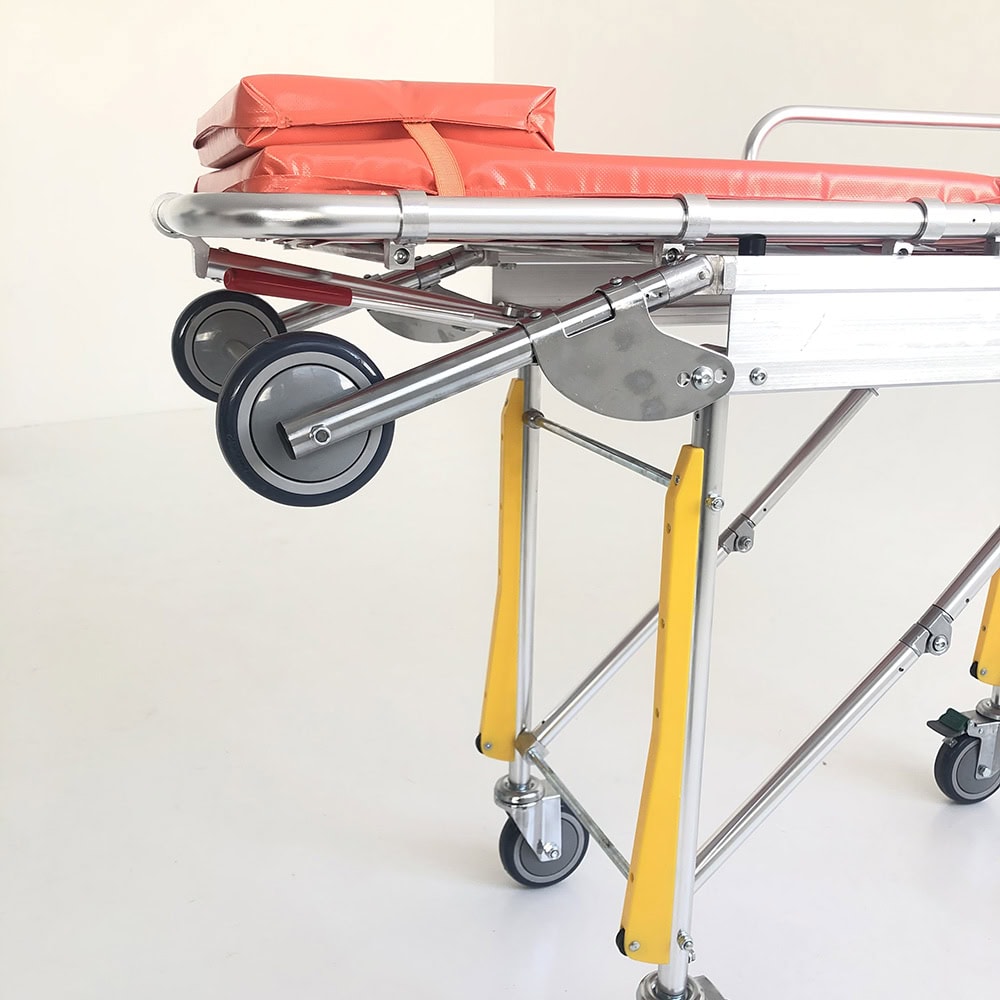
Best for: ambulance stretcher frames, scoop stretcher,stair chair stretcher, frames and latch/hinge parts, folding stretcher frames, side rails, linkages.
Why it works
- Light yet strong, supports complex shapes and folding mechanisms; spare parts are easy to source.
- Handles routine hospital cleaning (always follow the product IFU and the disinfectant label).
Heads-up
- Welded areas can be softer than the T6 base (HAZ softening). Designers typically add ribs/thickness, avoid critical welds, or heat-treat after welding to compensate.
Carbon fiber : lighter, stiffer, cleaner images
Good for: spine board, scoop stretcher that go straight into imaging; premium lightweight parts.
Why it works
- Light and stiff, so carries feel easier.
- Fewer image artifacts (cleaner pictures) than titanium in MRI/CT.
Evidence: Scientific Reports study on CF-PEEK screws and MRI artifacts (link); PubMed comparison vs. titanium implants (link).
Heads-up
- Heat tolerance depends on the resin (ask your supplier’s datasheet).
- Edge dings matter: good products add edge protection; do a simple drop/impact check when you receive it.

HDPE (high-density polyethylene): impact-proof and weather-ready
Good for: spine boards, scoop stretcher, Multifunctional Rescue Stretcher
Why it works
- Tough and low-absorption—wipes clean fast.
- Many grades list a working range near –50 °C to +80 °C (confirm per datasheet).
Datasheets to file with infection control/biomed: - HDPE sheet data (–50 to +80 °C): PDF
- HDPE technical data (service temps by grade): PDF
Heads-up
- Less stiff than metal—designers use thicker panels or ribs where spans are large.
- Skip high-heat sterilization by default; use chemical disinfection per CDC/EPA and check material compatibility.
Links: CDC procedures • EPA About List N

Side-by-side at a glance
| What you care about | Aluminum | Carbon fiber | HDPE |
|---|---|---|---|
| Typical use | Ambulance stretcher frames, scoop stretcher, stair chair stretcher, folding frames, rails | Imaging-friendly spine boards, premium light parts, scoop stretcher | Spine boards, , scoop stretcher , Multifunctional rescue stretcher |
| Big win | Strong, fixable, parts are easy to source | Cleaner images in CT/MRI, very light & stiff | Impact & chemical resistant, wipes clean |
| Watch-outs | Welds need smart design/heat treatment | Protect edges; heat limit comes from resin | Lower stiffness—use ribs/thickness; avoid high heat |
| Proof/link | 6061-T6 data | Sci Rep 2020 • PubMed 2021 | HDPE datasheet |
Cleaning reminder: follow CDC procedures and choose products from EPA’s List N search.
Buying fast, buying right (works for all stretcher types)
- Want easy maintenance and spares → start with aluminum.
- Need to image on the board with fewer artifacts → look at carbon fiber.
- Expect wet, cold, or knock-prone use → HDPE is reliable.
- Collect from suppliers: material datasheet/TDS + cleaning compatibility note (aligned to CDC/EPA).
- Check the factory has ISO 13485 quality system (scope should cover design/production/service).
ISO links: ISO 13485 standard • ISO overview
Quick FAQ
Is a carbon-fiber spine board really better for imaging?
Yes. Peer-reviewed studies show smaller CT/MRI artifacts vs. titanium: Scientific Reports 2020 • PubMed 2021.
Will an HDPE board get brittle in winter?
Most grades list –50 °C to +80 °C service. Avoid hard point impacts at extreme cold.
Data: HDPE (–50 to +80 °C) • HDPE technical data
Does welding weaken aluminum stretcher frames?
Weld heat-affected zones can be softer than base T6; engineers design around that or heat-treat after.
Reference: NASA 6061 handbook
Call to action
Speccing an ambulance stretcher, scoop stretcher, spine board, or stair chair stretcher? Send us your use case + budget + timeline. We’ll return a short Material × Scenario shortlist and a Cleaning Compatibility one-pager aligned to CDC/EPA.
👉 Learn more and request a tailored recommendation: Jiekang Rescue.
Or email us your requirements—we aim to reply within 12 hours with options and quotes.