
Introduction
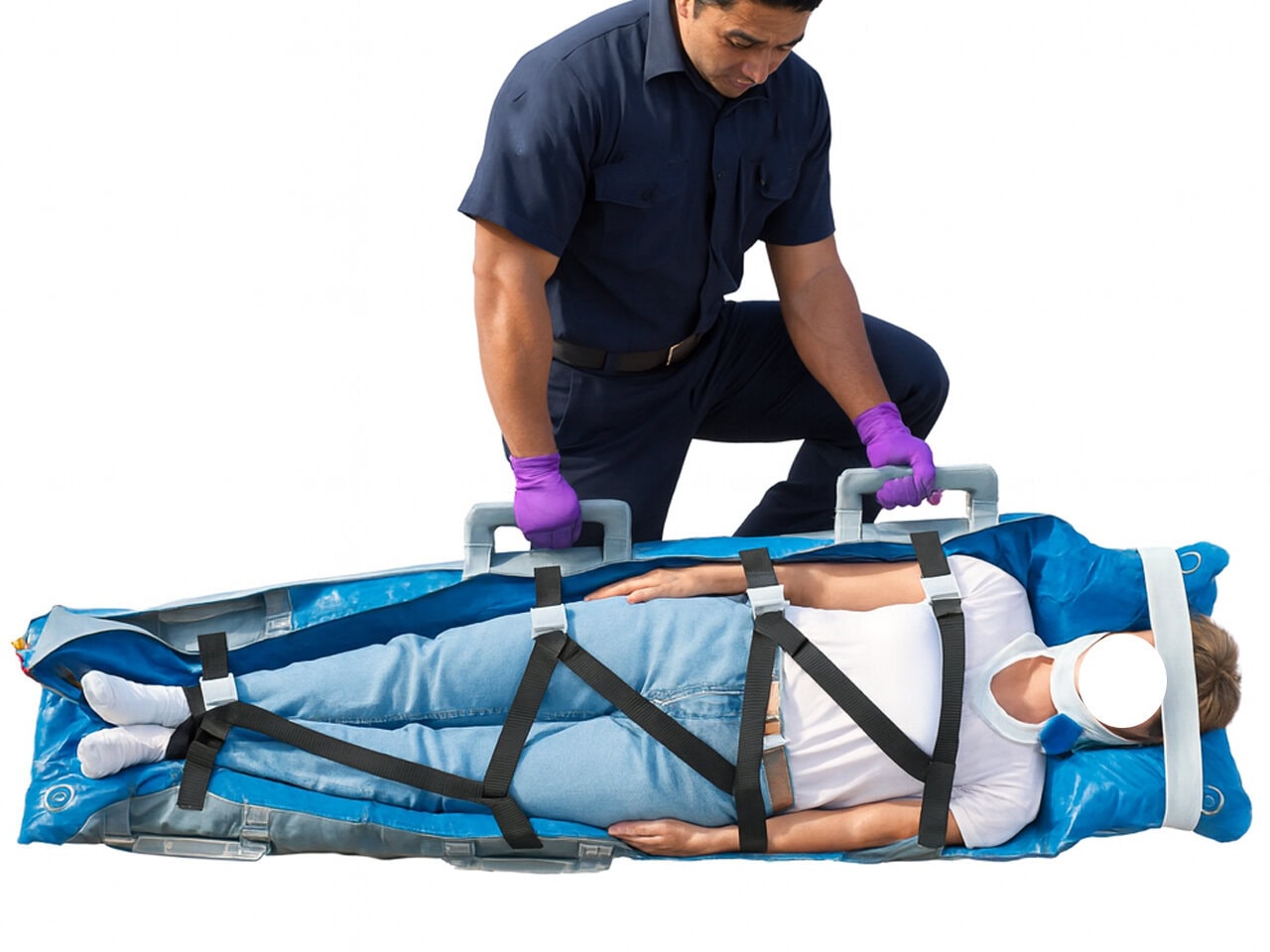
Every EMS team knows the classic rigid backboard. It’s cheap, fast, and standard for decades. But ask trauma patients about comfort, or check the latest research, and you’ll see why vacuum mattress stretchers are gaining ground.
The debate is no longer “do they work?” but “when is a vacuum mattress better than a spine board?”
In this guide we’ll:
- Compare specs and prices of 6 leading vacuum stretchers
- Summarize the latest evidence on stability, comfort, and scene-time
- Offer a decision tree: when mattress beats board
- Provide a 5-step mini-guide to application
- Review pros and cons for real EMS buyers

Specs & Price Table: 6 Leading Vacuum Mattress Stretchers
| Brand / Model | Weight | Dimensions | Load Capacity | Features | Price (USD) |
|---|---|---|---|---|---|
| SAM Medical Vacuum Mattress | 7.5 kg | 210×90 cm | 250 kg | Durable TPU cover, 12 handles | 1,800–2,200 |
| Ferno VACU-MAT | 8.0 kg | 207×92 cm | 225 kg | X-ray & MRI compatible, quick-release valve | 2,000–2,400 |
| Spencer S-MAX | 9.0 kg | 210×88 cm | 230 kg | 16 handles, flame-retardant PVC, high insulation | 2,100–2,500 |
| Stryker Vacuum Spine Mattress | 8.5 kg | 208×90 cm | 250 kg | Reinforced seams, ergonomic pump | 2,400–2,800 |
| MeBer Vacuum Stretcher | 8.2 kg | 210×90 cm | 230 kg | Washable cover, 10 handles, compact storage | 1,700–2,100 |
| RedVac (Kohlbrat & Bunz) | 7.8 kg | 205×88 cm | 250 kg | Widely used in HEMS, antibacterial coating | 2,500–3,200 |
Data compiled from SAM Medical, Ferno, Spencer, Stryker, MeBer, and TheFireStore catalogs.
Evidence Grid: Vacuum Mattress vs Spine Board
Research from recent years has tested stability, comfort, and operational efficiency.
| Outcome | Vacuum Mattress | Spine Board | Key Evidence |
|---|---|---|---|
| Spinal stability | Equal or superior, esp. in thoracolumbar region | Good, but higher micro-movements | BMJ EMJ |
| Patient comfort | Significantly superior, less pain & pressure ulcers | Poor, high discomfort | PMC Study |
| Scene-time | 1–2 min longer application | Faster by ~90 sec | PagePress Trauma Emerg Surg |
| Ulcer risk | Low (reduced tissue interface pressure) | High (rigid points of contact) | Emerg Med J |
| Helicopter EMS use | Widely adopted (comfort & vibration absorption) | Still used, less tolerated | Trauma Emerg Surg |
Bottom line: Vacuum mattresses win on comfort and long transport stability. Spine boards still win on speed and availability.
Decision Tree: Mattress vs Board
Ask these 3 questions in the field:
- Is this a suspected unstable spinal injury?
- Yes → Vacuum mattress if available.
- No / penetrating trauma → Spine board or scoop stretcher.
- Is transport likely >20 minutes (ground or air)?
- Yes → Vacuum mattress (reduces pain, ulcers).
- No (short scene-time, city EMS) → Spine board acceptable.
- Is patient in cardiac arrest?
- Yes → Spine board (fast CPR setup).
- No → Vacuum mattress preferred.
5-Step Mini-Guide to Vacuum Mattress Use
- Prepare: Place mattress flat, attach pump, open valve.
- Position: Log-roll or scoop transfer patient onto mattress.
- Mold: Adjust body alignment, spread beads evenly.
- Vacuum: Use pump until mattress becomes rigid and conforms to patient’s body.
- Secure: Strap across chest, pelvis, legs; monitor vitals.
Time: ~3–4 minutes with trained 2–3 providers.

Pros and Cons for EMS Buyers
Advantages of Vacuum Mattress Stretchers
- Better patient comfort, fewer pressure ulcers
- Superior immobilization for thoracolumbar injuries
- Ideal for HEMS and long transports
- Radiolucent (X-ray, CT, MRI compatible)
Disadvantages
- Higher cost (2–3× backboards)
- Slightly slower on-scene times
- Need training and maintenance (valves, pumps)
- Storage bulkier than boards
FAQs
Q1: Can vacuum mattresses replace spine boards completely?
Not yet. They’re better for long transport, but spine boards are still faster for quick extrication.
Q2: Do they work in helicopters?
Yes. Many HEMS prefer them for vibration absorption and patient comfort.
Q3: How long can a patient stay on a spine board safely?
Guidelines recommend <30 minutes due to ulcer risk.
Q4: Are vacuum mattresses safe for obese patients?
Yes, most models hold up to 250 kg. Always check manufacturer specs.
Q5: What’s the cleaning process?
Most come with washable TPU/PVC covers. Disinfect after each use.
Conclusion
Vacuum mattress stretchers are no longer “luxury gear”—they’re becoming essential in trauma and EMS, especially where comfort, stability, and long transport safety matter.
- Use spine boards for fast extrication and CPR.
- Use vacuum mattresses for suspected spinal injury, long transfers, and HEMS.
For EMS buyers: the smart setup is both tools in your fleet.
Looking for certified EMS equipment? Visit Jiekang.