

If you’re buying stretchers for government programs or rescue teams, “material” isn’t a spec-sheet detail—it’s an operational risk factor. Extreme heat and subzero cold can change grip, comfort, lock reliability, strap behavior, and even the patient’s thermal exposure.
This guide breaks down how common stretcher materials behave in harsh temperatures, what usually fails first, and how to match options to real deployments—so your teams aren’t field-testing procurement decisions.
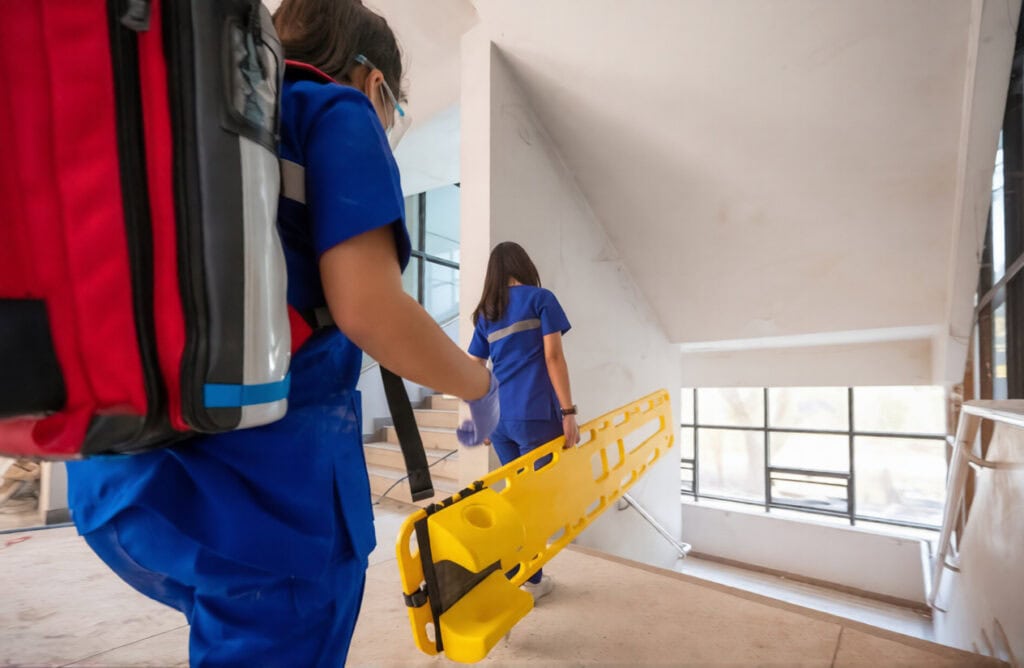
What extreme temperatures do to stretchers in the real world
High heat and deep cold don’t just affect patients—they also change how your stretcher works and how your team handles it. In real missions, you’ll usually run into four things:
- Hot surfaces + heavy PPE: metal rails and handles can get too hot to touch, and fatigue makes handling mistakes more likely.
- Cold + reduced dexterity: gloves, ice, and stiff straps slow down packaging and checks—small delays add up fast.
- Patient heat loss: metal transfers heat/cold much faster than most plastics, so contact surfaces can affect comfort and heat retention.
- Temperature swings: moving between warm stations and freezing outdoor scenes can wear down locks and joints over time.
Key takeaway: temperature performance is a system issue (frame + locks + straps + surface), not just “metal vs plastic.”estion (frame + locks + straps + surfaces), not just “metal vs plastic.”
The main stretcher material families you’ll be choosing from
Most rescue and patient transfer stretchers sit in these buckets:
- Aluminum alloy frames (common in scoop stretchers and many carry/transport designs)
- Plastics/polymers (common in spine boards and some scoop designs)
- Reinforced plastics / hybrid builds (polymer body + ribs + metal hardware)
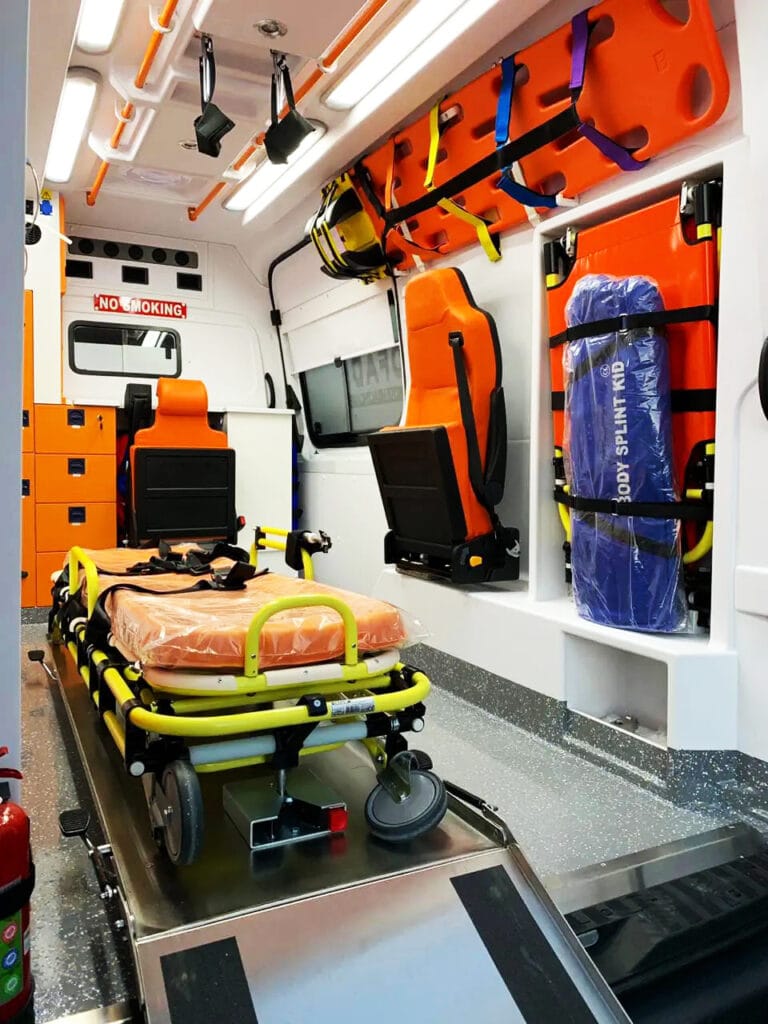
How aluminum behaves in extreme heat and cold
Extreme heat
Aluminum stays structurally strong in high temperatures, so load-bearing confidence is usually solid. But aluminum also conducts heat extremely well—about 237 W/m·K is often cited for aluminum, which is why it heats up fast under sun exposure.
What that means for deployments
- Hot-to-touch risk goes up on exposed handles and rails
- Crews rely more on gloves and grip technique
- Patient contact areas may need padding/insulating layers
Extreme cold
Aluminum remains mechanically reliable in freezing temperatures, but it transfers cold quickly. That can increase patient heat loss unless you build thermal layers into your SOP.
Practical procurement note: In cold regions, aluminum can still be the right choice—if your program includes thermal padding and a strict insulation protocol. OSHA/NIOSH cold guidance repeatedly stresses layered protection and mitigation measures.
How plastics and composites behave in extreme heat and cold
Extreme heat
High-quality polymers usually feel less “burn-risk” under sunlight because their thermal conductivity is much lower than metals (common plastics are often around 0.17–0.5 W/m·K, depending on type).
The real heat risk for plastics is UV + long-term outdoor exposure, which can embrittle many polymers without stabilizers. Peer-reviewed work on polypropylene (PP) shows UV exposure can degrade mechanical properties, and stabilizers can meaningfully change outcomes.
Subzero cold
Cold performance varies wildly by polymer family and formulation.
- Some polymers become hard/brittle below their glass transition behavior (Tg) concepts—below Tg many polymers behave more “glassy” and brittle.
- PP, for example, is often associated with embrittlement around its glass transition region (around -10°C is referenced in technical literature for PP matrix behavior).
- Polyethylene (PE/HDPE) is frequently recognized for strong low-temperature impact resistance in many applications, and technical literature discusses very low ductile-to-brittle transition temperatures for PE in certain contexts.
Bottom line: “Plastic” is not one thing. Ask what polymer it is (HDPE? PP? composite?) and whether cold impact testing exists.

Quick comparison table for project buyers
| Decision Factor | Aluminum Alloy | High-Quality Polymer/Composite |
|---|---|---|
| Heat handling | Can become very hot in sun; gloves/padding needed | Often safer-to-touch; watch UV aging |
| Cold handling | Very cold surface; higher thermal transfer to patient | Often better thermal comfort; confirm brittle behavior/testing |
| Lock/joint reliability | Hardware tolerances matter; ice/sand can jam | Hardware still matters; polymer around hardware can crack if low-grade |
| Cleaning cycles | Strong; watch coating scratches → future corrosion points | Strong; confirm disinfectant compatibility + strap longevity |
| Best-fit missions | Heavy lift confidence, rugged daily EMS | Thermal comfort, corrosion resistance, some imaging-friendly designs |
What fails first in harsh climates
Most of the time, a stretcher doesn’t “break in half.”
What stops a rescue is usually the small parts that get stuck, worn out, or damaged.
Here are the parts that fail first—especially in heat, cold, sand, mud, or salt air:
- Locks & latches: sand, ice, or mud can jam them, so the stretcher won’t open/close smoothly.
- Straps & buckles: sunlight ages straps, cold makes them stiff, and buckles can crack if hit or dropped.
- Surface coating/finish: scratches make the stretcher harder to clean, and coatings may peel over time.
- Accessories & fittings: pads, head immobilizers, and carry bags often wear out earlier than the stretcher itself.
Simple rule for buyers: don’t just buy a “strong frame.” Buy a setup that stays usable after repeated resets in bad weather.
How to choose the best stretcher material for your deployment profile
Use this simple decision flow (procurement teams love this because it’s defensible in documentation):
- Define your true temperature range (operational worst-case, not city averages)
- List your top 3 mission types (evacuation, transfer, extrication, water/ice, etc.)
- Identify your biggest failure risk (locks? straps? contamination? patient thermal exposure?)
- Select material + design that reduces that risk
- Require spares + documentation in the contract
RFQ checklist you can copy into government procurement docs
Use this to force clarity from suppliers (and avoid “trust me” answers):
- What is the exact material (alloy grade / polymer family) and what testing exists for low/high temp performance?
- Can locks be operated with gloves, and do they resist ice/sand/mud jamming?
- What are the replacement parts (straps, buckles, locks) and lead times?
- Does the product include UV stabilization for outdoor storage/long exposure?
- What disinfectants are compatible, and how does the design support fast drying/reset?
- Provide documentation: user manual, inspection checklist, maintenance schedule.
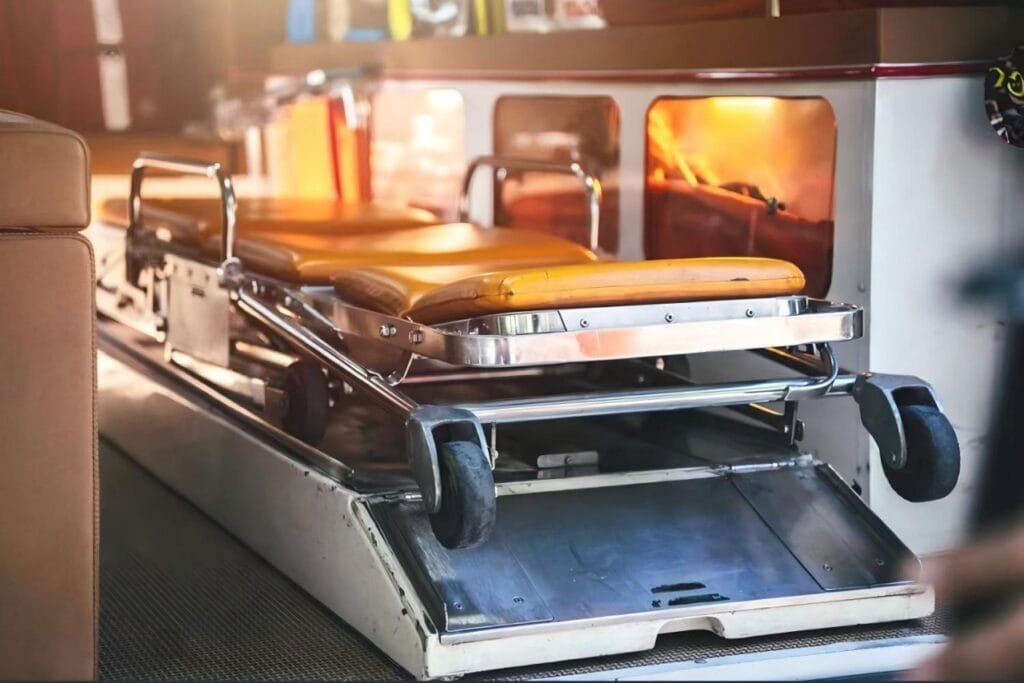
Recommendation for government and rescue teams
So, which stretcher materials perform best in extreme heat and cold?
No single material “wins” everywhere. Aluminum often delivers excellent rigidity and lifting confidence, while high-quality polymers/composites can offer better thermal comfort and corrosion resistance—especially when outdoor exposure and repeated wet cleaning are part of the mission. The best procurement decision is the one that matches your worst-case environment, and includes lock/strap reliability plus spare-part support.
If you want to review stretcher options for mixed rescue use, our category page is here: https://jiekangrescue.com/various-rescue-stretcher/
Homepage: https://jiekangrescue.com/
We’re a factory-direct manufacturer supplying rescue and patient handling equipment for bulk and project procurement. If you’re building an extreme-climate program, we can help you choose configurations, provide documentation packs, and support stable long-term supply.
- About us: https://jiekangrescue.com/about-us/
- Contact us for quote / catalog / project discussion: https://jiekangrescue.com/contact-us/