
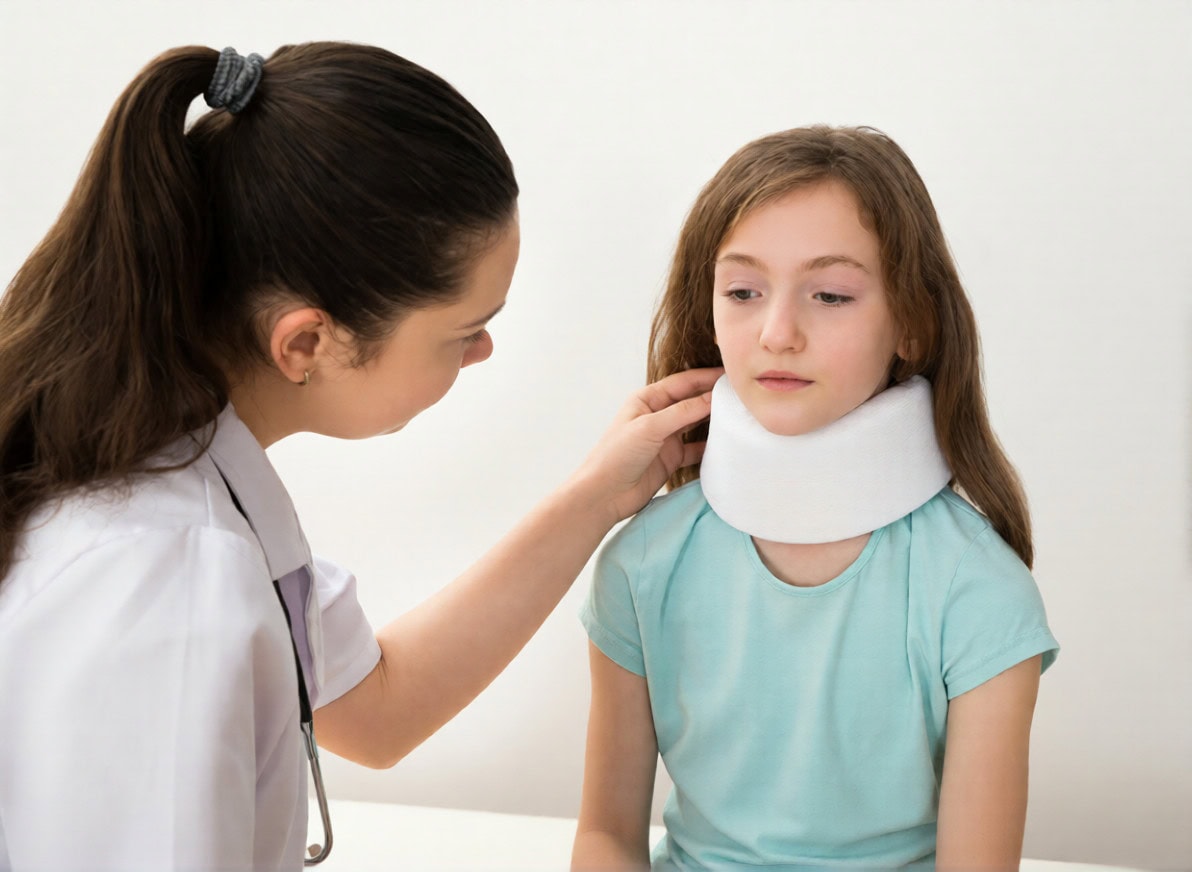
Why pediatric spinal immobilization must be treated “differently”
In emergency care and trauma transport, pediatric spinal immobilization is both critical and more challenging than most teams expect. Children are not “small adults”—their body proportions, skeletal development stage, and physiological characteristics are different, which means pediatric patients require pediatric-specific methods and equipment.
For example, children typically have a proportionally larger head and a more flexible cervical spine. If you place a child on an adult spine board and use an adult collar, it’s easy to force the neck into flexion or hyperextension—potentially affecting the airway or worsening an underlying spinal cord injury. Pediatric transports may be a smaller share of total ambulance runs, but when they happen, they are high-risk, zero-shortcut situations.
So whether you’re an EMS provider, a training lead, or a hospital/EMS procurement team, you must make sure you have:
- A properly sized pediatric cervical collar (Pediatric C-Collar)
- A pediatric-appropriate spinal immobilization plan
- A team that knows exactly how to use both correctly
Multiple international guidelines and standards emphasize this point. For instance, the European ambulance standard EN 1789 requires ambulances to carry pediatric spinal immobilization devices. In North America, many EMS organizations repeatedly stress that children must never be transported unrestrained or “improvised-secured.”

Key differences between pediatric vs. adult collars and spine boards
Understanding why adult gear can’t simply be “reused” is the foundation for correct technique.
| Key Difference | What You’ll See in Real Use | Why It Matters | What to Do |
|---|---|---|---|
| Body size & proportions | Pediatric boards are shorter/narrower; adult boards feel oversized | Strap positions shift, security drops | Use pediatric boards when possible; if using adult boards, modify correctly |
| “Big head, narrow shoulders” | Lying flat on an adult board pushes the chin toward the chest | Classic dangerous cervical flexion pattern | Elevate the torso (not the head) to restore neutral alignment |
| Collar sizing | Adult collars often don’t adjust small enough | Can compress the jaw/airway or fail to stabilize | Stock infant/child sizes or true pediatric-adjustable collars |
| Pediatric-friendly design | Strap paths and contact points differ | Better comfort = less struggling = safer immobilization | Use straps that land on chest + pelvis (not abdomen/neck) |
1) Body size & proportion differences
Pediatric spine boards are usually shorter and narrower, built for a child’s torso. Adult boards are often too large, causing strap points to land in the wrong places and making secure restraint harder.
2) Collar sizing issues
Even adjustable adult collars often won’t adjust small enough for infants and young children. Pediatric collars usually come in infant/child sizes or use pediatric-focused adjustment ranges.
An oversized collar may:
- Compress the jaw or airway
- Fail to limit cervical movement
- Increase risk instead of reducing it
If you don’t have a hard collar that truly fits, a rolled towel or soft alternative is often safer than forcing a rigid collar that is clearly wrong-sized.
3) Design and restraint approach
Pediatric boards and restraint systems typically:
- Place straps where they belong on a child’s chest and pelvis
- Use softer contact surfaces to reduce pressure and fear
- Improve comfort while maintaining stability
A calm, comfortable child is less likely to struggle—meaning the immobilization is more effective and safer.
4) Neutral alignment (the most important part)
For pediatric patients, the hardest part isn’t “strapping down.” It’s achieving a true neutral position.
On an adult spine board, you should elevate the torso, not the head, to maintain neutral cervical alignment. This point is repeatedly emphasized in EMS training guidance.

Measuring and fitting a pediatric C-collar (Step-by-Step)
Step 1: Continuous manual stabilization
Before applying the collar, one rescuer must maintain the head/neck in neutral alignment manually.
If there is obvious deformity or strong resistance, do not force correction. Support the child in the position found.
Step 2: Measure neck height
A practical method:
- Measure from the top of the trapezius/shoulder to the underside of the jaw
- Use the “finger method” to estimate height (e.g., 2-finger, 3-finger)
This measurement determines collar height or adjustment setting.
Step 3: Select the right size
Based on the measurement:
- Fixed-size collar: choose the closest match
- Adjustable collar: set to the corresponding height marking
Principle: slightly larger is better than too small, but it must not compromise the airway.
Step 4: Place the collar correctly
With manual stabilization maintained:
- Place the front piece first so the chin sits correctly in the chin support
- Close the back piece
- Ensure the collar maintains a natural neutral position—don’t “push” the neck into a new posture
Step 5: Secure and check
- Straps should be snug, not tight
- “One-finger check” for tightness
- Head movement should be clearly limited, while breathing and swallowing remain unaffected
Step 6: Recheck and adjust
Look for:
- Hyperextension (collar too tall)
- Flexion (collar too short)
- Jaw pushed inward or airway restricted
If needed, re-size or re-adjust immediately.

Correct pediatric positioning on a spine board (Step-by-Step)
Step 1: Choose the right immobilization tool
Use a pediatric spine board whenever possible.
If only an adult board is available, you must modify positioning.
Step 2: Prepare torso elevation in advance
Place padding under the child’s back (shoulders to waist) to elevate the torso by about 2–3 cm, allowing the head to fall into neutral alignment naturally.
Key principle:
Pad the body, not the head.
Step 3: Transfer as a single unit onto the board
Use log-roll or a coordinated slide technique. Maintain head-neck-torso alignment throughout.
Step 4: Align head and torso
Confirm:
- Ear lobe aligns vertically with the shoulder
- Neck is neither flexed forward nor extended backward
Step 5: Strap in the correct sequence
Standard sequence:
- Torso
- Pelvis
- Legs
- Head last
This prevents body movement from transferring stress to the cervical spine.
Step 6: Fill natural voids
Use towels or soft padding to fill lumbar/neck gaps as needed, reducing movement and discomfort.
Step 7: Final checks
- Breathing is smooth
- Straps are not compressing
- Head is stable
- No change in limb sensation or reported symptoms
Risks caused by wrong sizing or wrong positioning
| Common Problem | What It Can Cause |
|---|---|
| Airway compression | Breathing difficulty, aspiration risk |
| Cervical flexion or hyperextension | Increased spinal cord risk, alignment failure |
| Ineffective immobilization | Movement during transport, secondary injury risk |
| Impaired blood flow / increased ICP | Head injury risk amplified, distress worsened |
| Child fear + struggling | More movement → higher secondary injury risk |
Most of these risks come from equipment mismatch or non-standard technique, not from the device itself.

Standards and industry consensus (Quick view)
| Standard/Organization | Core Message |
|---|---|
| EN 1789 | Ambulances should carry pediatric spinal immobilization devices |
| NASEMSO | Pediatric transport must be properly restrained throughout |
| AAP / ACEP / ACS | Ambulances should stock pediatric collars and immobilization systems |
| Many EMS protocols | Pediatric positioning must be handled as a distinct scenario |
Turn “the right method” into a “reliable setup”
In pediatric spinal immobilization, doing the technique correctly is only the first step. Long-term consistency comes from whether your equipment coverage is complete, sizes truly fit, and the system is designed around pediatric reality.
If you’ve run into issues like:
- Adult collars “kind of work” but clearly don’t fit
- Size coverage is incomplete, making training hard to standardize
- Positioning/padding varies by provider and becomes inconsistent
…it’s often more effective to revisit equipment selection than to repeat the same technique reminders.
If you want a more structured breakdown of pediatric collar sizing logic, adjustment ranges, and procurement considerations, you can also read:
how-to-choose-the-right-pediatric-cervical-collar
In real projects, we often support hospitals, EMS teams, ambulance upfitters, and distributors by mapping out:
- Pediatric collar size coverage across age bands
- How collars integrate with spine boards and head immobilizers
- Materials, disinfection workflows, and durability for high-frequency use
- OEM/ODM options for color, labeling, and training materials
If you’re planning or upgrading a pediatric immobilization setup, you can share your typical patient age ranges, current equipment list, and cleaning requirements with our team. We’ll help you translate “how to do it” into a configuration that’s easier to standardize and train.
Contact us: https://jiekangrescue.com/contact-us/
Learn more about us: https://jiekangrescue.com/